When a fairy tale decides to escape the pages of a book and lands in the heart of a metropolis, something greater than just a movie is born. Enchanted is a story where magic doesn’t hide in fictional kingdoms; instead, it unexpectedly sprouts amidst the honking of taxis, the looming skyscrapers, and the frantic daily rhythm of New York City. This Walt Disney Pictures film transforms the city into a stage where reality and fantasy intertwine so tightly that the line between them almost disappears. In this article on new-york-trend.com we’ll uncover the exact filming locations of Enchanted in New York, how familiar landmarks took on a new, almost magical aura, and why after watching, you’ll want to see these places for yourself—as if to check if a little bit of Disney magic was left behind.
A Fairy Tale Hits the Pavement
Enchanted is a rare case where Walt Disney Pictures doesn’t just tell a fairy tale—it literally drops it into the real world and watches what happens.
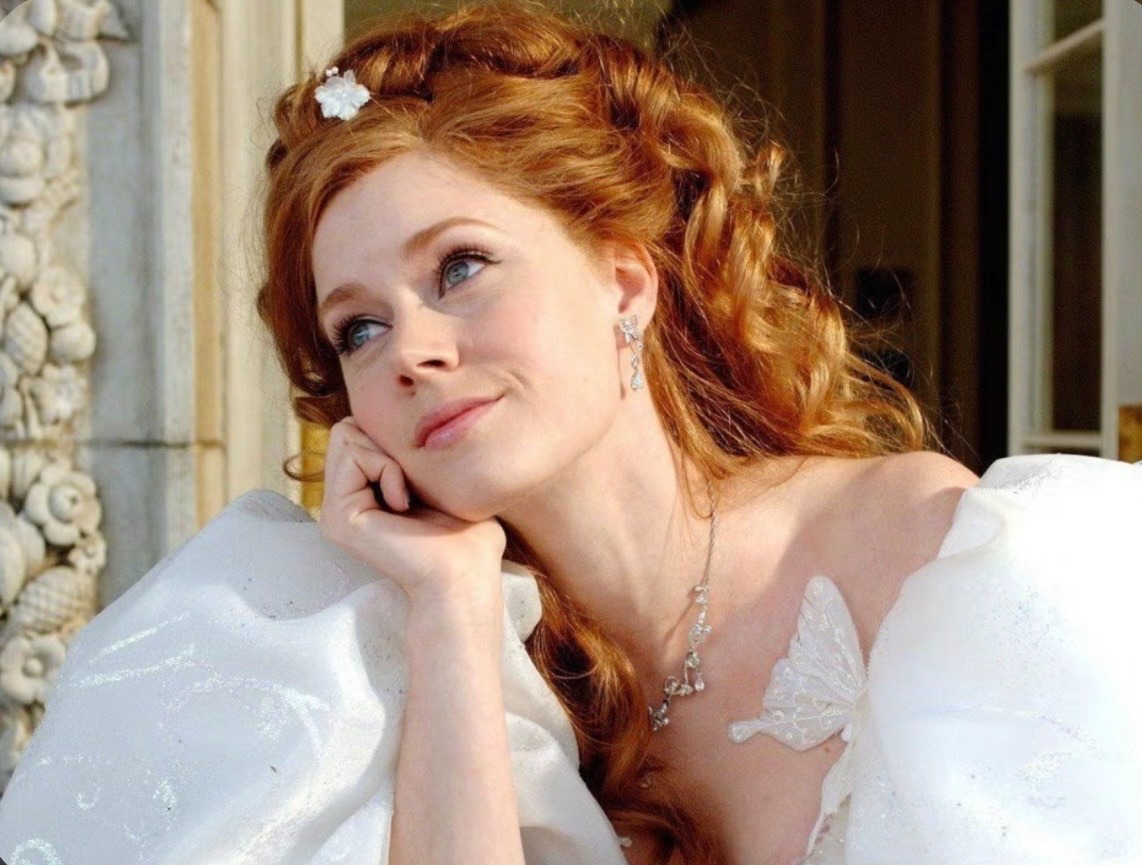
Directed by Kevin Lima, the film blended classic animation, live-action cinema, and a healthy dose of self-irony regarding the Disney legacy. At its center is Giselle, a princess who, instead of a “happily ever after,” finds herself stranded in modern-day New York.
In the fictional land of Andalasia, everything follows the laws of a classic fable: spontaneous singing, instant true love, and wedding preparations. But after the interference of an evil queen, that world collapses, and Giselle is thrust into Manhattan. Released in 2007, the film grossed over $340 million and established Amy Adams as one of the leading actresses of her generation.
Fun Facts about “Enchanted”:
- The script was originally much darker. Early versions of the story were more adult-oriented and even provocative. The studio completely reworked the tone to make it a family-friendly film.
- The search for Giselle was extensive. Actresses like Kate Hudson and Reese Witherspoon were considered, but after over 200 auditions, Amy Adams was chosen.
- A casting session that “cured” the director. Kevin Lima recalled having a high fever during the auditions but became so captivated by Adams’ performance that he temporarily forgot he was sick.
- The animation wasn’t done by Disney. Following the closure of Disney’s 2D department, the classic animation sequences were handled by James Baxter Animation.
- A dress that burned calories. Giselle’s wedding gown weighed about 45 pounds; the actress found it extremely difficult to move during filming.
- The song we never heard. Despite her powerhouse vocals, Idina Menzel’s musical number was cut from the final version.
Times Square — A First Taste of the City
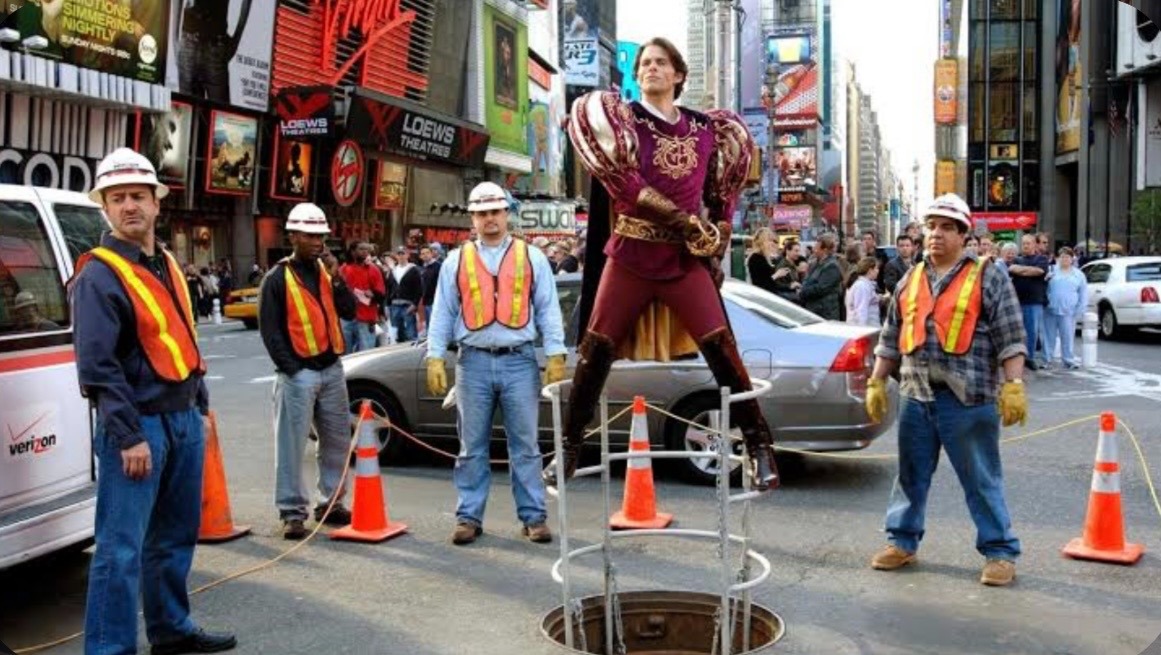
The scene where Giselle first emerges into the real world wasn’t filmed on a studio lot or a closed-off street; it was shot in the very heart of Times Square.
And that was a deliberate choice.
The director consciously gave up total control over the environment. Times Square wasn’t cleared of people or turned into a sterile set—it was left alive, unmanaged, and unpredictable. This is why the scene where Giselle climbs out of a manhole feels so authentic; she literally lands in the middle of the real city, not a sanitized cinematic version of it.
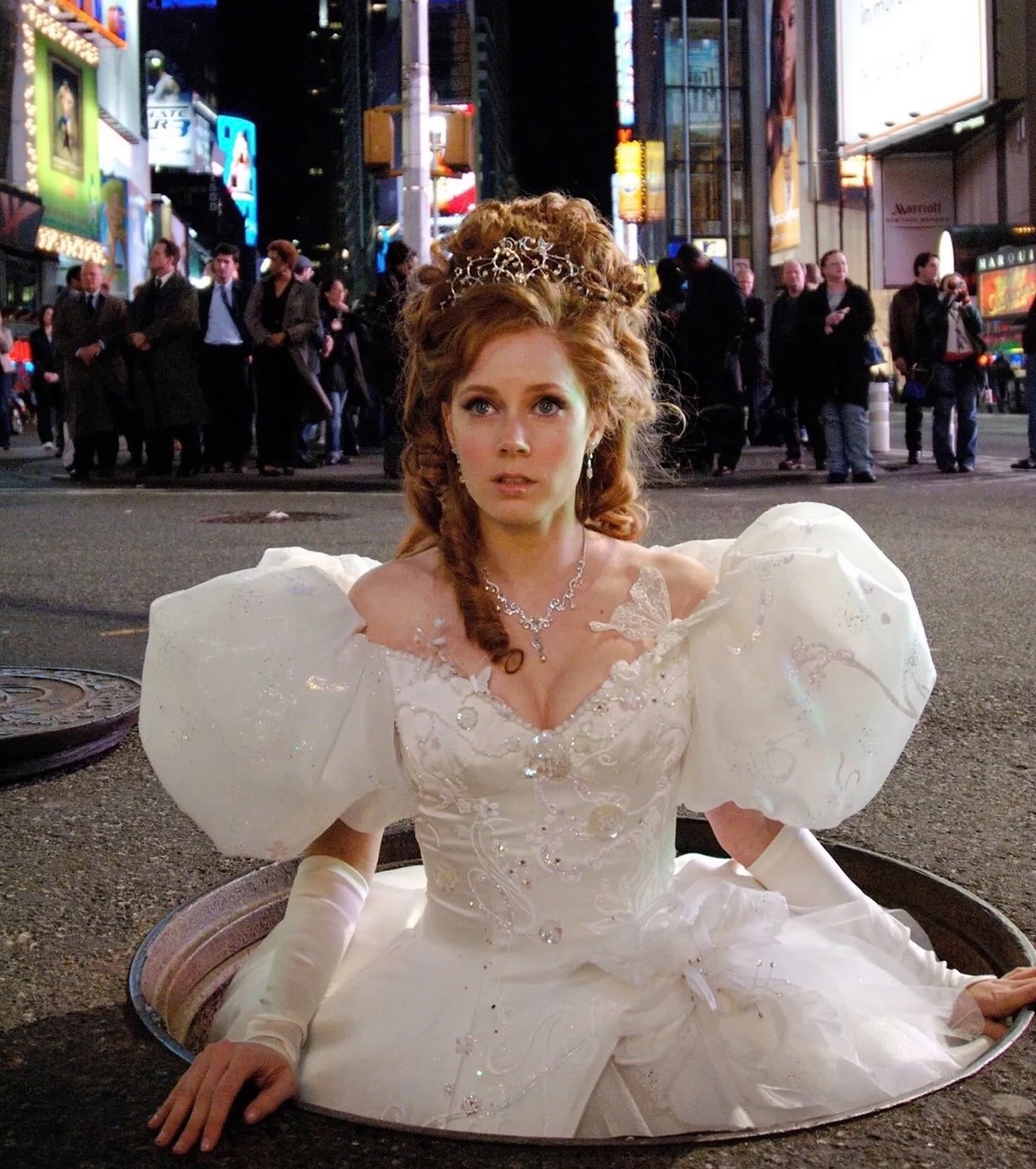
The filming process here was a compromise between staging and documentary-style filmmaking. While the actors and hired extras were in the foreground, ordinary commuters were right behind them—many of whom didn’t even realize they were in a movie. It was impossible to fully control the crowd, so the camera caught the genuine reactions of the city: surprised glances, random movements, and the true street rhythm.
This created massive logistical hurdles. The lighting shifted constantly due to the massive digital billboards, the ambient noise made synchronized sound recording difficult, and the crowd could ruin a take at any moment. During scenes featuring James Marsden and Timothy Spall, onlookers would gather to watch the process, which the crew had to work around.
But these limitations became the scene’s greatest strength. The camera doesn’t isolate Giselle from her environment; it embeds her in it. Her heavy, multilayered gown, her whimsical movements, and her sincere confusion contrast sharply with the flow of people rushing about their business. This contrast isn’t artificial—it happens right there in the frame. As a result, the scene works almost like a documentary: a fairy-tale character enters a New York that is noisy, chaotic, and completely indifferent.
Dancing in the Crowd: How “Enchanted” Won Over Central Park
The musical number “That’s How You Know” is pure live-action New York magic. As Giselle sings and dances alongside professionals and casual passersby, Central Park is transformed into a literal storybook playground. The camera doesn’t just focus on her choreography; it captures the beautiful chaos of the city—cyclists, joggers, and tourists with selfie sticks—making it feel as though a cartoon princess has truly crashed into the real-world metropolis.
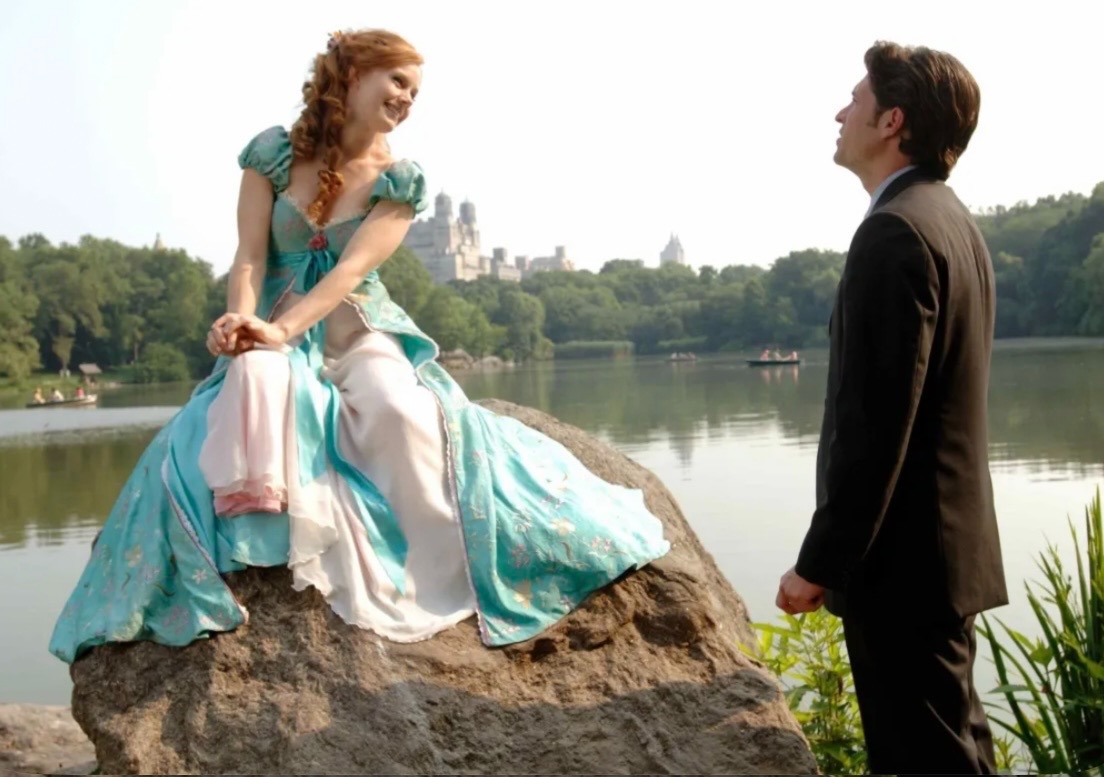
Pulling off this scene was no small feat. It took 17 days to film, though only seven of those were actually sunny. The production involved 450 participants, including 150 professional dancers and 300 extras. Amy Adams had to perform high-energy moves in a massive, heavy gown, while Patrick Dempsey’s fans constantly swarmed the area, making it necessary to call in extra security. Director Kevin Lima and choreographer John O’Connell meticulously mapped out a route that allowed the camera to “chase” Giselle through the park’s most picturesque corners.
In this sequence, Central Park isn’t just a backdrop—it’s a living character that sustains the fairy tale within the city’s concrete rhythm. The historic fountains, Gothic bridges, and Victorian structures allow Giselle to be herself without breaking the logic of modern urban life.
Central Park locations that stole the show:
- Conservatory Water – The starting point of the song, famous for its model sailboats.
- Gapstow Bridge – The iconic 1896 Gothic bridge offering a stunning view of the Midtown skyline.
- The Dairy – A Victorian structure built in 1870, originally serving as a milk pavilion.
- Naumburg Bandshell – The classic performance stage for the orchestra.
- Bow Bridge – The elegant cast-iron bridge spanning the Lake.
- Bethesda Terrace & Fountain – The grand finale of the number at the “Angel of the Waters” fountain.
- Sheep Meadow – The massive green lawn perfect for city picnics.
- Reservoir Bridge – An exquisite bridge used for the high-energy chase sequences.
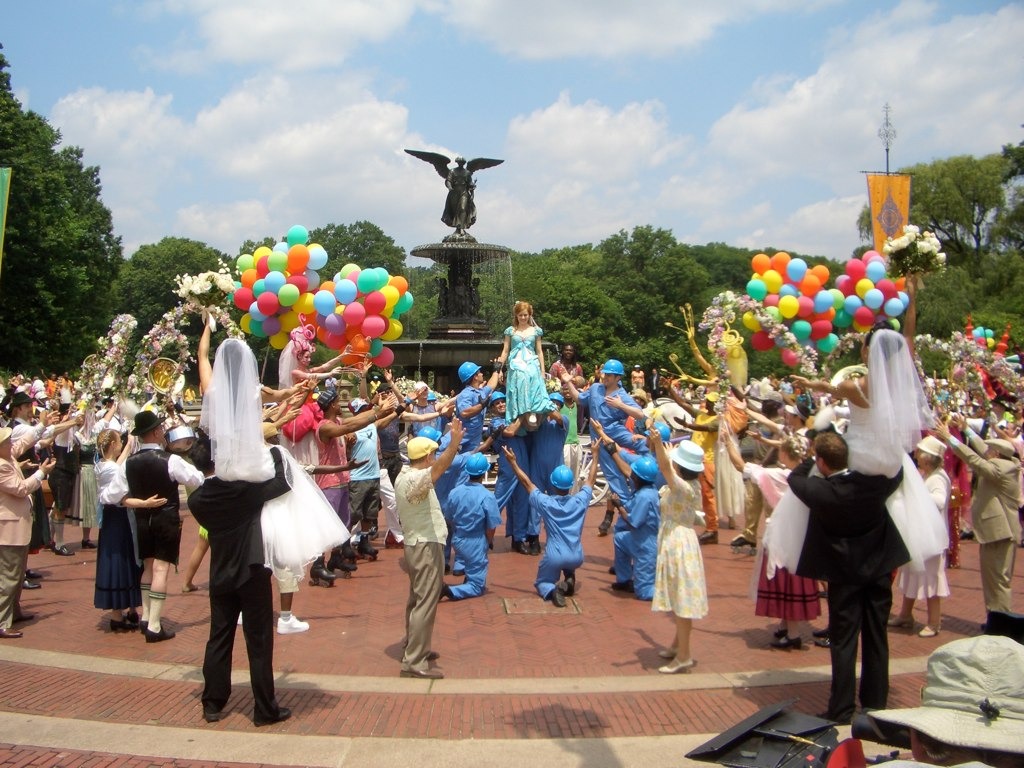
This musical number earned an Oscar nomination for Best Original Song, and the Bethesda Fountain remains a top destination for tourists looking to find a bit of the magic Giselle brought to the heart of the park.
NYC Streets and Facades: The City as a Co-Star
While many interior scenes were filmed at Steiner Studios, the true charm of the movie lies on the pavement of New York, where the city’s pulse is woven into the fairy tale. Giselle navigates through 43rd Street and 7th Avenue before heading into the subway. A lingering shot on Howard Street featuring a homeless man adds a layer of raw, daily realism to the whimsical story.
Corporate buildings and residential blocks also play their parts. 875 3rd Avenue serves as the law firm’s office. Coenties Slip provides the setting for a street food scene, while a crucial bus sequence was shot on 7th Avenue between 46th and 47th Streets. The magical showdown involving the Queen occurs at the intersection of West 42nd Street and 7th Avenue, with the camera focusing on the fountain near the AllianceBernstein Building.
The use of real-world interiors adds even more authenticity. The Time Warner Center (now the Deutsche Bank Center) is Robert’s workplace, and the legendary Katz’s Delicatessen serves as the diner where the characters get a literal taste of the city. We see the exterior of Robert’s home at 440 Riverside Drive, Prince Edward’s “castle” at The B Hotel & Hostel, and various local boutiques like Cutler Salon and shops on Mercer Street.
The Brooklyn Bridge stands as another vital symbol, appearing in a final shot of Giselle and Robert’s stroll. The bridge is more than just an aesthetic choice; it represents Giselle’s transition from fantasy to reality, proving that a fairy tale can exist in the real world if you believe in love and wonder.
Enchanted treats New York as a primary character. Every location reflects the mood of the scene, highlighting the collision of fantasy and the mundane. Magic feels believable here because it lives among the actual streets, bridges, and facades of New York City.